Blog

What is a "real" country? - Part 1
20/01/2026
• Note: This blog post was originally written in early November 2025, which should give context to some statements relating to Greenland.
• Note: This blog post is one of a series to come relating to the topic of what makes a country legitimate.
Often, I find myself asking certain questions, through day to day life, be it the mundane in day to day life (Why do I never see a car from my own country as I jog past the local hotel every day, but I do regularly see cars from much further afield) to the more abstract that I bore myself, those around me, and you the reader. Today is very much in the realm of the abstract. What is a real country?
I find that I am dismissive of certain things in life. Certain names will never sit right with me. The man who invented Toblerone was named Tobler. I would be amazed if he could walk into a bank with his head held high and expect to get a loan. Even in Switzerland, I think a banker would hesitate when confronted with a man with such a name. I thought about this often by myself, and felt validated on the concept upon hearing Steve Merchant of "The Ricky Gervais Show" fame wax lyrical about ridiculous names. As he rightly pointed out; you can indeed simply say the name of a band and laugh à propos of nothing if they call themselves “The Lilac time". After expanding my interest in geography, particularly geopolitics, it was inevitable that I would begin to apply this dismissive attitude towards nation states at some point. To note that this is purely meant for the amusement of myself and others in a healthy debate context over a beer as opposed to the opposite extreme of delegitimising a nation state for political means (see Germany and the USSR view on Poland in 1939, or equally Putin and Ukraine today in 2025).
Let’s start with a few ground rules. I am going to limit my discussion to Europe today as it is the region I understand best. Equally we would be here until the cows come home if I discuss all 200 recognised countries according to the UN (sorry Western Sahara). Next, what I consider as a country requires to have met my standard of a real country. I note that there exists 4 criteria under international law for recognition of a state according to the 1933 Montevideo Convention: Having a permanent population, having a defined territory, having a government, Having the ability to enter into relations with other states. It is clear that certain territories meet all these criteria according to many but not all (Palestine comes to mind). Other territories equally would not meet these criteria according to many (China or Taiwan depending on one’s point of view). All of this is to say that I feel comfortable making up my own rules as to what makes a nation a nation, in as much as others are clearly equally making up their own rules. For me, the country must have its own language, or at least at a bare minimum a highly altered dialect (Swiss German and Quebecois would be good examples here). Every region in the world can claim to have its own distinct culture and this is true more often than not (though less true than before due to the advent of globalisation) so this is simply not good enough to justify a nation state by itself.
Secondly, the country must have a legitimate reason for being, for independence. A desire for political change, self-determination, separation from another nation are all excellent points in my scale. Countries created as political or military footballs will be immediately failing here. Think of the North / South Korea divide if we briefly step out of Europe to give an example. There is one Korea, and that is a legitimate and real country. Both the PRK and ROK however fail (especially the PRK) this test somehow denying the Korean people a legitimate nation.
A country, a real country must have some substance, some stuff, some semblance of being able to do some things by themselves. Their own airline would be sterling here but not an absolute requirement. I will however be expecting an independent bank, currency (or a stake in the currency used), transport service, chain of shops, etc. Otherwise, what is there to stop someone buying their own plot of land, inventing some nonsense language and calling themselves a real country. In short: Mickey Mouse countries what we all know well will indeed be getting the boot. We also DO hope that the door hits them on the way out!
Naturally, a sovereign state should be exactly that. Sovereign and independent. That is to say that any foreign influence on the political, economic or military makeup of the country can severely reduce its credibility in my scale. This can be from the minute scale such as the Holy See recruiting their Swiss guard from the Swiss military to larger scale organisations such as the IMF meddling in the economic affairs of countries (normally due to their own failings). My country is guilty of the later itself. The United States amongst other countries such as France have military bases in other independent nations around the world. This also reduces the credibility of these nations hosting the military of others. We can believe it would be a cold day in hell before the USA allows any of the countries they walk into to have military bases in one of their 50 states.
Caveats notwithstanding; these shall broadly be our requirements for real nations. So, let’s get started working our way from top to bottom in Europe. At the top we start with Greenland. Home according to some of Santa Claus, snow and not so many people. Of course this is not officially a country, but recent developments have brought forward discussions of independence from Denmark towards Greenland being a nation state of its own. Let’s evaluate their case. We need to look no further than the recent storm in a teacup that was the discussed US acquisition of Greenland. We won’t got into the likely ulterior motives the Trump administration had for bringing this up (and it is not the first time that the US has tried to buy Greenland after all). Suffice it to say that any response from Greenland itself or Denmark (Denmark being in union with Greenland since 1814) that is not absolutely dismissive of the idea should itself question the legitimacy of the nation making said statement. This of course much to do with the nation(s) wanting to protect their until now excellent relationship with the US military and businesses. This context is important but is still simply not good enough. We only need to look at France, mostly removed from this situation coming to the defence of Greenland far more than Denmark or Greenland itself. How can we seriously be expected to call this place a real country when it will not outright refuse any such proposal. Hurling vitriol is the only appropriate response. I briefly mentioned the US military presence in Greenland, apparently key for their ongoing cold war against Russia and China. That’s nice for them but it does nothing towards the legitimacy of Greenland who rely on Denmark officially for their defence. On top of this, let’s not forget Greenland using Danish business to keep afloat economically as well as using Danish equally with Greenlandic as a lingua franca. There can be no surprise when I conclude that Greenland is without a doubt not a real country, and will not be should they become officially independent from Denmark in the future (unless many aspects change).
Let’s move on down towards Iceland. Immediately we are already looking much better than in Greenland. Icelandic an independent, distinctive and culturally unique language being actively spoken at home and in the workplace is a huge tick. Much like Greenland, it was a Danish possession for much of its history, from 1814 until 1944. We can say since then that it is truly independent as a nation with its own national institutions. Again, when compared to Greenland, we can see drastic economic differences. The country has an excellent self-sustained economy. Due to its geographic location, there is an abundance of natural energy sources solving problem number 1 for any country. The tourism industry is notable. Who amongst us do not know someone who has travelled to Iceland. They have their own regulated currency and transport services. There are few points by which we can question the legitimacy of this nation. Iceland does have its own standing navy (well coast guard to be exact), however does have a military installation effectively shared with the USA. The links are more tenuous than in the past when America maintained this base themselves, but the fact that they have not been booted out entirely loses Iceland some legitimacy points. I cannot think of many other negative points, so I cannot do anything except consider it a legitimate nation.
I should note at this time that I shall not treat the case of all countries. Only those that I or others I have discussed with have questioned the legitimacy of. With that in mind, the next countries that I intent to examine shall be the Faroe Islands, Luxembourg, Liechtenstein, Monaco, Andorra and Austria. See you in the next edition, coming soon!
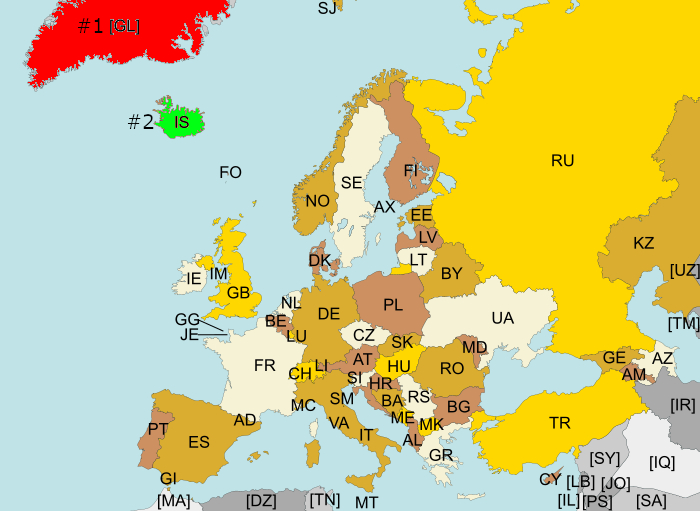
2 down, many to go. 1 imposter and 1 legitimate state so far.